
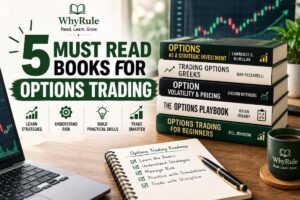
5 Must Read Books for Options Trading
Introduction
Options trading can look incredibly attractive when you first discover it.
You see traders discussing call options, put options, strike prices, premiums, expiry dates, implied volatility, option Greeks, spreads, hedging, and leverage—and it can feel like there is an entirely different language to learn.
And there is.
Options are more complex than simply buying and selling stocks because an option’s value can be affected by several factors at the same time.
That is why learning options trading from a structured source can be much more useful than jumping between social-media tips, random strategies, and short videos.
The right options trading books can help you understand how options actually work, why option prices change, how volatility affects premiums, and—most importantly—how risk can be managed.
In this guide, we’ll look at 5 must-read books for options trading, particularly for readers who want to build their knowledge from the basics toward more advanced concepts.
Important: Options trading involves significant risk and can result in substantial losses. Some option strategies can create losses greater than the initial amount paid or deposited. These books are educational resources, not guarantees of profitable trading.
Quick Overview: 5 Must-Read Options Trading Books
| Book | Author | Best For |
|---|---|---|
| Understanding Options | Michael Sincere | Complete beginners |
| Options as a Strategic Investment | Lawrence G. McMillan | Comprehensive options education |
| Trading Options Greeks | Dan Passarelli | Understanding option Greeks and risk |
| Option Volatility & Pricing | Sheldon Natenberg | Volatility and professional options concepts |
| The Option Trader’s Hedge Fund | Dennis A. Chen & Mark Sebastian | Strategy and portfolio-level options thinking |
Now let’s look at what each book can teach you.
Why Read Books About Options Trading?
Before getting into the individual books, it’s worth understanding why options require a different learning approach.
When you buy a stock, the basic relationship is relatively straightforward:
Stock price rises → Your position gains value
Stock price falls → Your position loses value
Options are different.
An option’s value can depend on:
- Underlying asset price
- Strike price
- Time remaining
- Implied volatility
- Interest rates
- Market expectations
- Type of option
- Position structure
This creates a much more complicated relationship between the market and your position.
For example, you could correctly predict that a stock will rise and still lose money on an option trade if the move is too small, happens too slowly, or volatility changes unfavorably.
That’s why options education should begin with understanding the mechanics, not with searching for the “best option strategy.”
1. Understanding Options — Michael Sincere
Author: Michael Sincere
Best for: Beginners learning options trading from scratch
If you’re completely new to options, starting with an accessible introduction can save you a lot of confusion.
Understanding Options by Michael Sincere is designed to introduce readers to the basic concepts behind options and how they are used.
Rather than assuming you already understand derivatives, the book provides a foundation for learning the language of options.
What Is an Option?
An option is a financial contract that gives the buyer a right, but not an obligation, to buy or sell an underlying asset at a specified price according to the terms of the contract.
There are two basic types.
Call Option
A call option gives the holder the right to buy the underlying asset at the strike price under the contract’s terms.
Put Option
A put option gives the holder the right to sell the underlying asset at the strike price under the contract’s terms.
The option buyer pays a price called the premium.
Why the Premium Matters
Suppose a hypothetical stock is trading at ₹500.
You purchase a call option with:
- Strike price: ₹520
- Premium: ₹10
You aren’t simply buying the stock.
You’re buying an options contract with its own value and expiration.
The option’s value can change based on the stock price, time remaining, and volatility, among other factors.
That distinction is essential for beginners.
What Beginners Can Learn
A beginner-oriented options book should help you understand concepts such as:
- Calls
- Puts
- Strike price
- Premium
- Expiration
- Intrinsic value
- Time value
- In-the-money options
- At-the-money options
- Out-of-the-money options
- Basic option strategies
These concepts form the vocabulary you’ll need before moving into advanced options strategies.
Why This Book Is Useful
One of the biggest mistakes beginners make is jumping straight into complicated strategies such as:
- Iron condors
- Butterflies
- Calendar spreads
- Straddles
- Strangles
without understanding the underlying mechanics.
A foundational book helps reverse that process.
First understand the option. Then understand the strategy.
Best For
Absolute beginners who want to understand options terminology and mechanics before exploring advanced trading strategies.
2. Options as a Strategic Investment — Lawrence G. McMillan
Author: Lawrence G. McMillan
Best for: Comprehensive options strategy education
If you’re looking for a more comprehensive options trading book, Options as a Strategic Investment is an important title to know.
Lawrence G. McMillan’s book covers a wide range of options concepts and strategies.
It goes significantly deeper than a basic introduction.
Why Is This Book Important?
Options aren’t only tools for speculation.
They can also be used for:
- Hedging
- Income strategies
- Risk management
- Portfolio protection
- Directional trading
- Volatility strategies
- Structured positions
This broader perspective is important.
Instead of thinking:
“Options = quick profits”
you can start thinking:
“Options = financial instruments with different risk and reward characteristics.”
Understanding Option Strategies
One of the useful aspects of the book is its broad coverage of strategies.
Depending on the edition and context, readers encounter concepts involving:
- Covered calls
- Protective puts
- Spreads
- Straddles
- Strangles
- Combinations
- Hedging
- Volatility
- Portfolio strategies
The important thing isn’t memorizing every strategy.
It’s understanding why a strategy exists.
Example: Covered Call
Imagine an investor owns shares of a company.
They could potentially sell a call option against those shares.
This is commonly called a covered call.
The investor receives an option premium, but there is a trade-off: if the stock rises significantly beyond the strike price, the investor’s upside can be limited according to the position’s structure.
This illustrates an important options lesson:
Every strategy involves trade-offs.
There isn’t a strategy that simply creates extra returns without changing risk.
Example: Protective Put
Suppose an investor owns shares but wants downside protection.
A put option can potentially be used as a form of insurance-like protection.
The investor pays a premium for that protection.
Again, there is a trade-off.
Protection has a cost.
This way of thinking is much more useful than asking whether a strategy is simply “bullish” or “bearish.”
Who Should Read It?
This book is particularly useful for:
- Serious options learners
- Investors wanting broader strategy knowledge
- Intermediate traders
- Readers studying options beyond the basics
For a complete beginner, it may be better approached after learning basic options terminology.
3. Trading Options Greeks — Dan Passarelli
Author: Dan Passarelli
Best for: Understanding option Greeks and managing risk
If you’ve spent any time researching options, you’ve probably encountered words such as:
- Delta
- Gamma
- Theta
- Vega
These are commonly known as the option Greeks.
For beginners, they can initially seem complicated.
But understanding them is extremely important because they help explain how an option’s price may respond to different changes in market conditions.
Trading Options Greeks focuses specifically on this subject.
What Are Option Greeks?
Let’s simplify them.
Delta
Delta measures how much an option’s price is expected to change for a given change in the underlying asset, all else equal, under the model’s assumptions.
For example, a call with a delta of approximately 0.50 would theoretically change by around ₹0.50 for a ₹1 move in the underlying, all else equal.
It is not a guarantee.
Gamma
Gamma describes how quickly an option’s delta changes as the underlying price changes.
This becomes especially important when managing positions as the market moves.
A trader who ignores gamma may misunderstand how quickly their exposure can change.
Theta
Theta is associated with the effect of time passing on an option’s theoretical value, all else equal.
This is why people often describe options as having time decay.
For option buyers, time passing can work against the position if other factors don’t compensate for it.
Vega
Vega measures sensitivity to changes in implied volatility.
This is extremely important because option prices aren’t determined only by whether the underlying stock goes up or down.
A change in expected volatility can materially affect an option’s premium.
Why Greeks Matter
Imagine you buy a call option because you expect a stock to rise.
The stock rises slightly.
You might assume:
“My prediction was correct, so my option should make money.”
But the actual result can depend on:
- How much the stock moved
- How quickly it moved
- Time remaining
- Implied volatility
- Strike price
- Delta
- Other position characteristics
This is why understanding Greeks can significantly improve your understanding of options.
What This Book Can Teach
Trading Options Greeks can help you explore:
- Delta
- Gamma
- Theta
- Vega
- Position management
- Volatility
- Risk exposure
- Options pricing behavior
- Strategy construction
Best For
Traders who understand basic calls and puts and want to understand how option risk changes.
4. Option Volatility & Pricing — Sheldon Natenberg
Author: Sheldon Natenberg
Best for: Volatility, pricing, and deeper options knowledge
If options trading is a subject you’re serious about studying, volatility is something you cannot ignore.
And that’s where Option Volatility & Pricing becomes especially valuable.
Sheldon Natenberg’s book is widely known among options traders for its detailed treatment of options pricing and volatility.
It is more advanced than a typical beginner book, but it can become extremely useful once you understand the basics.
What Is Implied Volatility?
Here’s a simplified explanation.
Implied volatility represents the market’s expectation of future price variability as reflected in option prices.
It isn’t simply a prediction that the stock will go up or down.
Instead, it relates to how much movement the market is pricing into the option.
This is one reason two options on the same stock can behave very differently.
Why Volatility Matters
Imagine a stock trading at ₹1,000.
An option with one month remaining might have a particular premium.
Now suppose market participants suddenly expect significant price movement.
Implied volatility could rise.
That can increase option premiums, all else equal.
The reverse can also happen.
This is why an options trader needs to think about more than direction.
The question isn’t simply:
“Will the stock rise?”
It can also be:
“What level of movement is already reflected in the option price?”
Volatility Is Not the Same as Direction
This is an important concept for beginners.
A stock can:
- Rise with falling implied volatility
- Fall with rising implied volatility
- Remain relatively stable while volatility changes
- Make a large move while an option still performs differently than expected
This makes options fundamentally different from simply buying shares.
What Can You Learn?
The book explores areas such as:
- Option pricing
- Implied volatility
- Historical volatility
- Volatility strategies
- Greeks
- Option valuation
- Trading strategies
- Risk management
Who Should Read It?
This is better suited to:
Intermediate traders who already understand basic options and want to develop deeper knowledge of volatility and pricing.
Don’t be discouraged if it feels difficult initially.
It’s a book you can return to multiple times as your options knowledge develops.
5. The Option Trader’s Hedge Fund — Dennis A. Chen & Mark Sebastian
Authors: Dennis A. Chen & Mark Sebastian
Best for: Strategy, portfolio thinking, and risk management
Many beginners approach options one trade at a time.
They ask:
“What’s the best options strategy today?”
But experienced options education often involves thinking at the portfolio level.
That’s one reason The Option Trader’s Hedge Fund is interesting.
The book presents options trading from a broader strategy and portfolio-management perspective.
Thinking Like a Portfolio Manager
Imagine you have five different options positions.
Looking at each position separately might not tell you the full story.
You also need to understand:
- Total portfolio exposure
- Directional risk
- Volatility exposure
- Correlation
- Position concentration
- Maximum potential loss
- Capital requirements
This is a much more sophisticated way of thinking about options.
Why Risk Management Matters
Suppose you have a strategy that wins 7 out of 10 trades.
That sounds impressive.
But if the three losing trades are much larger than the seven winning trades, the overall strategy can still lose money.
This illustrates a fundamental principle:
Win rate alone doesn’t determine profitability.
You also need to understand:
Position size + average win + average loss + costs + risk exposure
Options Are About Trade-Offs
Every strategy has a structure.
A strategy might provide:
- Higher probability of profit
but potentially:
- Smaller profits when successful
Another strategy might offer:
- Larger potential reward
but:
- Lower probability of success
Understanding these trade-offs is much more valuable than searching for a “perfect” strategy.
What Can You Learn?
This book can help readers explore:
- Options strategies
- Portfolio management
- Risk management
- Position sizing
- Volatility
- Income-oriented strategies
- Trade management
- Systematic thinking
Best For
Intermediate options traders who want to move beyond individual trades and think more systematically about options portfolios.
Which Options Trading Book Should You Read First?
You don’t need to read all five books at the same time.
Choose according to your current level.
| If You Want to… | Start With |
|---|---|
| Learn options from scratch | Understanding Options |
| Study a wide range of strategies | Options as a Strategic Investment |
| Understand Greeks | Trading Options Greeks |
| Learn volatility and pricing | Option Volatility & Pricing |
| Think about options as a portfolio | The Option Trader’s Hedge Fund |
A sensible learning sequence is:
Basics → Strategies → Greeks → Volatility → Portfolio Management
This can be much easier than jumping directly into advanced options strategies.
Options Trading Concepts Every Beginner Should Understand
Before trading options with real money, make sure you understand these concepts.
1. Call Option
A call gives the buyer the right, but not the obligation, to buy the underlying asset at the strike price according to the contract terms.
2. Put Option
A put gives the buyer the right, but not the obligation, to sell the underlying asset at the strike price according to the contract terms.
3. Strike Price
The strike price is the price specified in the option contract for exercising the option.
4. Premium
The premium is the price paid to purchase an option.
For an option buyer, this is generally the amount paid upfront for the option.
5. Expiration
Options have a defined expiration under their contract terms.
Unlike shares, an option does not simply remain in existence indefinitely.
This makes time a crucial factor.
6. Intrinsic Value
Intrinsic value represents the amount by which an option is in the money, subject to the option type and contract terms.
For example, a call with a strike below the underlying’s current price has intrinsic value.
7. Time Value
An option can also have value because there is still time remaining before expiration.
As expiration approaches, this time-related component generally declines, all else equal.
8. Implied Volatility
Implied volatility reflects the market’s expectation of future price variability as embedded in option prices.
It can change even when the underlying asset barely moves.
9. Option Greeks
The Greeks help traders understand how an option’s theoretical value and risk exposure may respond to changes in:
- Underlying price
- Time
- Volatility
The most commonly discussed Greeks are:
Delta, Gamma, Theta and Vega.
Why Beginners Should Be Careful With Options Leverage?
Options can provide significant exposure with less upfront capital than purchasing the underlying asset outright.
That can make them attractive.
But leverage works in both directions.
A relatively small move in the underlying can produce a much larger percentage change in an option’s value.
That means:
Potentially greater capital efficiency ≠ lower risk.
In fact, leverage can make risk management even more important.
Buying Options vs Selling Options
Another major concept beginners should understand is the difference between buying and selling options.
Option Buyer
An option buyer pays a premium.
The maximum loss for a standard long call or long put is generally limited to the premium paid, assuming no additional positions or costs.
But the option can lose value rapidly as expiration approaches.
Option Seller
An option seller receives a premium but takes on an obligation if assigned according to the contract.
The risk profile can be significantly different.
Certain uncovered option-selling strategies can expose traders to very large or potentially theoretically unlimited losses.
That’s why beginners should understand the risk profile of a strategy before using it.
Common Options Trading Mistakes Beginners Make
1. Trading Without Understanding Expiration
An option is time-sensitive.
You need to understand exactly what happens at expiration.
2. Ignoring Implied Volatility
Being correct about direction isn’t necessarily enough.
Volatility can significantly affect option premiums.
3. Buying Cheap Out-of-the-Money Options
A low-priced option isn’t necessarily a bargain.
A ₹5 option can lose most or all of its value.
Price alone doesn’t determine whether an option is attractive.
4. Trading Too Many Strategies
Beginners sometimes try to learn:
- Iron condors
- Calendar spreads
- Butterflies
- Straddles
- Strangles
- Credit spreads
- Debit spreads
all at once.
That can create unnecessary confusion.
Master the basics first.
5. Ignoring Position Size
A strategy may look attractive on paper but become dangerous if the position is too large.
6. Treating Options Like Lottery Tickets
Options shouldn’t be approached simply because they offer the possibility of large percentage returns.
Understand the probability, risk, time horizon, and potential loss first.
A Beginner-Friendly Options Trading Learning Path
If you’re completely new to options, here’s a more practical approach.
Step 1: Learn the Language
Start with:
Understanding Options
Learn calls, puts, strikes, premiums, expiration, intrinsic value, and time value.
↓
Step 2: Study Different Strategies
Move to:
Options as a Strategic Investment
Understand how different option strategies create different risk/reward profiles.
↓
Step 3: Learn the Greeks
Read:
Trading Options Greeks
Understand delta, gamma, theta, and vega.
↓
Step 4: Study Volatility
Move to:
Option Volatility & Pricing
Learn why volatility is such an important part of option valuation.
↓
Step 5: Think in Portfolios
Explore:
The Option Trader’s Hedge Fund
Learn how individual positions can interact within a broader portfolio.
Should Beginners Trade Options Immediately After Reading These Books?
No.
Reading five books doesn’t automatically make someone ready to trade options with real money.
Knowledge needs to be tested through practice.
A beginner can first consider:
- Studying historical option chains
- Observing how premiums change
- Paper trading
- Building hypothetical positions
- Recording trades
- Studying option Greeks
- Understanding maximum loss
- Testing strategies
- Reviewing losing trades
A trading journal can be particularly helpful.
For each hypothetical trade, record:
Underlying → Strategy → Strike → Expiration → Premium → Entry → Exit → Maximum Risk → Result → Lesson
This creates a learning record instead of relying on memory.
How to Choose an Options Trading Book Based on Your Goal?
Want to understand options from zero?
Understanding Options
Want a comprehensive options reference?
Options as a Strategic Investment
Want to understand Greeks?
Trading Options Greeks
Want to understand volatility?
Option Volatility & Pricing
Want to understand portfolio-level options strategies?
The Option Trader’s Hedge Fund
There is no requirement to read them in one sitting.
Options education is better approached progressively.
Final Thoughts: 5 Must-Read Books for Options Trading
Options trading is a subject where shortcuts can become expensive.
A stock can move in the direction you predicted and your option can still behave differently from what you expected.
That’s why understanding time, volatility, Greeks, strategy structure, position sizing, and risk management is so important.
These five books provide different pieces of that education:
Understanding Options gives beginners the foundation.
Options as a Strategic Investment provides a much broader view of options strategies.
Trading Options Greeks explains the key risk sensitivities behind option positions.
Option Volatility & Pricing takes you deeper into volatility and option valuation.
And The Option Trader’s Hedge Fund encourages a broader portfolio and risk-management perspective.
The biggest lesson for a beginner is simple:
Don’t start with the strategy. Start with understanding the risk.
Once you understand how options work, you can gradually study strategies, practice with hypothetical trades, and develop a process based on your own objectives and risk tolerance.
Options aren’t simply a faster way to trade stocks.
They are a different financial instrument with their own mechanics and risks.
Learn those mechanics first.
Read. Learn. Grow.