
Introduction
Most people think reading is simply about gaining knowledge.
You read a book, learn something interesting, finish the last page, and move on to the next one.
But what if reading could do something more valuable than simply giving you information?
What if the right books could change the way you behave?
A good book can introduce you to a better way of thinking. It can make you notice patterns in your daily life, question your decisions, and give you practical ideas that you can turn into habits.
But there is an important difference between reading about good habits and actually developing them.
Reading alone won’t make you disciplined.
Reading about exercise won’t make you fit.
Reading about productivity won’t automatically make you productive.
The real power of reading appears when knowledge becomes action, action becomes repetition, and repetition becomes a habit.
In our previous articles, we’ve explored books about focus, mental strength, emotional intelligence, confidence, and communication. These skills are all connected by one thing: what you repeatedly do every day.
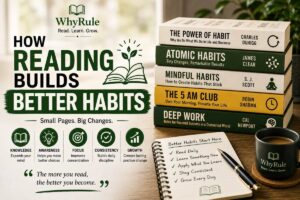
This article explores how reading builds better habits—and, more importantly, how to turn what you read into behavior that lasts.
You can explore more books on habits, mindset, productivity, and personal growth in our Self Development collection.
What Is a Habit?
A habit is a behavior that you repeatedly perform, often with little conscious effort.
Think about your normal day.
You probably have habits related to:
- Waking up
- Checking your phone
- Drinking tea or coffee
- Getting ready
- Working
- Eating
- Exercising
- Scrolling social media
- Reading
- Going to bed
Some habits help you.
Others quietly consume your time and energy.
The interesting thing is that habits don’t usually appear overnight.
They are built through repetition.
That’s why changing your life isn’t always about making one huge decision.
Often, it’s about changing the small behaviors you repeat every day.
How Can Reading Help Build Better Habits?
Reading can influence habits in several different ways.
1. Reading Increases Awareness
You can’t easily change a behavior you don’t notice.
A book can help you recognize patterns you previously ignored.
For example, you might think:
“I don’t have enough time.”
But after reading about productivity, you might realize that you spend an hour scrolling through your phone every evening.
The book didn’t create the problem.
It simply helped you see it.
And awareness is often the first step toward change.
2. Books Give You New Mental Models
We often repeat the same behavior because we believe the same things.
For example:
“I need motivation before I start.”
A book might introduce a different idea:
“Maybe action creates motivation.”
That’s a small change in thinking.
But it can lead to a completely different behavior.
Instead of waiting to feel motivated, you start for five minutes.
Once you begin, continuing becomes easier.
This is one of the biggest benefits of reading:
Books can give you better ways to interpret everyday situations.
3. Reading Gives You Practical Strategies
A good self-improvement book doesn’t only tell you:
“Be more disciplined.”
Atomic Habits is a good example of this approach because it focuses on making small changes that can become repeatable behaviors.
It can explain how to become more disciplined.
For example:
Instead of saying:
“Exercise more.”
A useful strategy might be:
“Put your workout clothes next to your bed the night before.”
Now the idea becomes practical.
You’re reducing friction between yourself and the behavior you want.
That is where reading becomes useful for habit formation.
4. Reading Creates Reflection
One of the biggest problems with modern life is that we’re constantly consuming information without reflecting on it.
Scroll.
Watch.
Read.
Scroll again.
A book can slow the process down.
When you read something that challenges your thinking, you have an opportunity to ask:
“Does this apply to my life?”
That question can turn passive reading into active learning.
5. Books Can Help You Understand Why You Behave the Way You Do
Sometimes we know exactly what we should do—but don’t do it.
You know you should sleep earlier.
You know you should exercise.
You know you should spend less time on your phone.
You know you should start that important project.
Yet the behavior doesn’t change.
Why?
Because knowing what to do isn’t the same as understanding why you keep avoiding it.
Books about habits and behavior can help you examine:
- Triggers
- Rewards
- Environment
- Motivation
- Procrastination
- Identity
- Repetition
- Friction
- Emotional patterns
Understanding the mechanism behind a behavior makes it easier to change.
Reading vs Applying: The Biggest Difference
Here’s something every reader should remember:
A book can give you the idea. You have to build the habit.
Imagine reading 20 books about productivity but never changing your routine.
You may become extremely knowledgeable about productivity.
But your daily life may look exactly the same.
Now imagine reading one useful book and applying one idea for 30 days.
That single idea could have a much bigger impact.
This is why the value of reading isn’t just about how much information you consume, but about how that information changes your behavior:
“How many books did I finish?”
A better question is:
“What changed because I read this book?”
How to Turn Reading Into Better Habits
Here’s a simple system you can use with almost any self-improvement book.
Step 1: Read With a Question
Don’t always open a book without knowing what you’re looking for.
Before starting, ask:
“What problem am I trying to solve?”
Maybe you’re struggling with:
- Procrastination
- Poor sleep
- Lack of focus
- Financial discipline
- Consistency
- Confidence
- Time management
Now you’re reading with a purpose.
You’ll naturally pay more attention to ideas that can help you.
Step 2: Don’t Highlight Everything
One common reading mistake is highlighting half the book.
If everything is important, nothing is important.
Instead, look for ideas that genuinely change your understanding.
When you find one, stop.
Ask:
“How could I apply this to my life?”
That’s more valuable than collecting dozens of highlighted sentences.
Step 3: Choose One Idea
This is one of the most important rules.
The principle is similar to the idea behind Essentialism: focus your energy on what matters most instead of trying to change everything at once.
One book → one major behavior change.
For example, you finish a chapter about morning routines.
Don’t suddenly create a routine with:
- Meditation
- Exercise
- Journaling
- Reading
- Cold showers
- Planning
- Walking
- No phone
- Visualization
You might follow it for three days and quit.
Instead:
Choose one.
For example:
“I will spend the first 15 minutes after waking up without checking my phone.”
That’s manageable.
Step 4: Make the Habit Extremely Small
A new habit doesn’t need to be impressive.
It needs to be repeatable.
Instead of:
“I’ll read for one hour every day.”
Start with:
“I’ll read two pages every night.”
Instead of:
“I’ll exercise for one hour.”
Start with:
“I’ll exercise for five minutes.”
Instead of:
“I’ll completely stop social media.”
Start with:
“I’ll keep my phone away during breakfast.”
Small actions reduce resistance.
And once a behavior becomes familiar, you can gradually increase it.
Step 5: Connect the New Habit to an Existing Habit
One simple technique is to attach a new behavior to something you already do.
For example:
After brushing my teeth → I’ll read two pages.
After making my morning coffee → I’ll write my top three tasks.
After lunch → I’ll walk for five minutes.
The existing behavior becomes a reminder for the new behavior.
This can make consistency easier than relying entirely on motivation.
Step 6: Change Your Environment
Your environment can make good habits easier or bad habits harder.
Suppose you want to read before sleeping.
Keep your book:
on your pillow or beside your bed.
Suppose you want to use your phone less.
Don’t keep it:
next to you while working.
Suppose you want to drink more water.
Keep a bottle:
within easy reach.
The principle is simple:
Make good habits easier to start and bad habits harder to start.
Step 7: Track Your Progress
You don’t need a complicated productivity system.
A simple calendar can work.
Every day you complete your habit, mark it.
For example:
| Day | Reading Habit |
|---|---|
| Monday | ✓ |
| Tuesday | ✓ |
| Wednesday | ✓ |
| Thursday | ✓ |
| Friday | ✓ |
| Saturday | ✓ |
| Sunday | ✓ |
The purpose isn’t to become obsessed with the streak.
It’s to make your consistency visible.
The Identity Shift Behind Better Habits
One of the most powerful changes happens when you stop thinking only about what you want to achieve and start thinking about who you want to become.
This idea also connects with The 7 Habits of Highly Effective People, which explores how principles and repeated behaviors can shape the way you live and work.
Instead of:
“I want to read more.”
Think:
“I am becoming someone who reads every day.”
Instead of:
“I want to exercise.”
Think:
“I am becoming someone who takes care of my body.”
Instead of:
“I want to become disciplined.”
Think:
“I am becoming someone who keeps promises to myself.”
Every repeated action provides evidence for your identity.
One reading session doesn’t make you a reader.
But hundreds of small reading sessions can change the way you see yourself.
Reading Can Also Help You Break Bad Habits
Reading isn’t only useful for creating good habits.
It can help you understand why bad habits continue.
Consider phone addiction.
You may think:
“I have no self-control.”
But perhaps your environment is designed around constant notifications.
Or perhaps you automatically reach for your phone whenever you’re bored.
Now you’ve identified a pattern.
The solution may not be:
“Try harder.”
It might be:
- Turn off unnecessary notifications
- Move distracting apps
- Keep the phone away while working
- Create phone-free periods
- Replace scrolling with another activity
Understanding the behavior allows you to redesign it.
Why Reading Every Day Can Become a Habit Itself
Reading is also an interesting example because reading can become the habit you’re trying to build.
Start with something extremely easy.
The 10-Minute Reading Rule
Choose a fixed time.
For example:
9:30 PM every night.
Read for just 10 minutes.
That’s it.
You don’t have to finish a chapter.
You don’t have to reach a certain page.
You simply have to show up.
After several weeks, the behavior can begin to feel normal.
Eventually, you may naturally read for longer.
The important thing is to make the beginning easy.
Don’t Read Too Many Self-Help Books at Once
This is another common problem.
You read one book about habits.
Then another about productivity.
Then another about discipline.
Then another about mindset.
Soon you’re consuming dozens of ideas but implementing none of them.
This creates the illusion of progress.
You feel productive because you’re learning.
But your behavior hasn’t changed.
The One Thing also reinforces the value of narrowing your attention instead of spreading it across too many competing priorities.
A better approach is:
Read → Apply → Observe → Adjust → Continue
Give an idea enough time to become part of your life before immediately replacing it with another.
Create a Personal Reading-to-Habit System
Here’s a simple system you can use for every self-improvement book.
Before Reading
Write:
“The problem I want to solve is ______.”
While Reading
Write down:
“The most useful idea is ______.”
After Reading
Ask:
“What one behavior will I change?”
For the Next 30 Days
Track:
“Did I actually do it?”
At the end of the month, ask:
“Did this idea improve my life?”
If yes, keep it.
If no, adjust it.
That’s how reading becomes practical.
5 Types of Books That Can Help Build Better Habits
You don’t need to read only books specifically titled “habits.”
Different categories can influence different areas of your behavior.
1. Habit & Behavior Books
These help you understand how habits are formed and changed.
Useful for:
- Breaking bad habits
- Building routines
- Understanding triggers
- Improving consistency
2. Productivity Books
These can help you develop better systems for:
- Time management
- Focus
- Prioritization
- Planning
3. Psychology Books
These can help you understand:
- Motivation
- Decision-making
- Emotional patterns
- Human behavior
4. Personal Finance Books
These can influence habits around:
- Saving
- Spending
- Investing
- Financial planning
5. Mindset & Personal Growth Books
These can encourage habits related to:
- Resilience
- Confidence
- Self-awareness
- Discipline
- Continuous learning
A Simple Example: Turning a Book Into a Real Habit
Imagine you read Deep Work, a book that explores the value of focused, distraction-free work.
You finish the chapter and think:
“I need to focus more.”
That’s an idea.
Now turn it into a behavior.
Old Routine
Work → Phone notification → Instagram → Message → YouTube → Work → Distraction
New Routine
Work starts → Phone goes away → 25 minutes focused work → 5-minute break → Repeat
Now the book has influenced your environment and behavior.
After repeating the system consistently, focused work becomes easier.
That’s when reading has created real-world value.
The 30-Day Reading & Habit Challenge
Try this simple experiment.
Days 1–7: Learn
Read for 10–15 minutes every day.
Don’t worry about finishing quickly.
Focus on understanding.
Days 8–14: Choose
Select one idea from what you’ve read.
Don’t add five new habits.
Choose one.
Days 15–21: Practice
Repeat that behavior every day.
Make it as easy as possible.
Days 22–30: Review
Ask yourself:
- Did I become more consistent?
- What made the habit difficult?
- What helped?
- What should I change?
- Do I want to continue?
At the end of 30 days, you’ll have something more valuable than another finished book:
a behavior you actually changed.
7 Rules for Reading That Actually Changes Your Life
Rule 1: Read With Purpose
Know what you’re trying to learn.
Rule 2: Take Fewer Notes
Focus on the ideas that matter.
Rule 3: Apply One Idea
Don’t try to change everything simultaneously.
Rule 4: Start Small
Make the behavior easy enough to repeat.
Rule 5: Change Your Environment
Don’t rely entirely on willpower.
Rule 6: Give It Time
Real behavioral change takes repetition.
Rule 7: Measure Application, Not Pages
Finishing a book is an achievement.
Using what you learned is the real goal.
Final Thoughts
Reading can change your life—but not simply because books contain valuable information.
The real transformation happens when an idea changes the way you think, your thinking changes what you do, and what you repeatedly do becomes part of who you are.
That’s why you shouldn’t feel pressured to read dozens of books every year.
One book that changes one important behavior can be more valuable than twenty books you barely remember.
So the next time you finish a great book, don’t immediately ask:
“What should I read next?”
Ask:
“What should I do differently now?”
Choose one idea.
Make it small.
Repeat it.
Give it time.
Then let the next book build on what you’ve already changed.
Because the ultimate goal of reading isn’t to become someone who knows more.
It’s to become someone who lives better.
Read. Learn. Grow.