
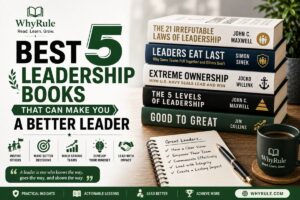
Best 5 Leadership Books That Can Make You a Better Leader
Introduction
Leadership is often misunderstood.
Many people think being a leader means having authority, giving instructions, making important decisions, or managing a team. But real leadership goes much deeper than that.
A good leader knows how to communicate clearly, take responsibility, make difficult decisions, motivate people, handle pressure, and create an environment where others can perform at their best.
And the interesting thing is—you don’t need to be a manager or CEO to develop leadership skills.
You can practice leadership as a student, employee, entrepreneur, team member, parent, or even while working on your personal goals.
Books can be an excellent way to learn these skills because they allow you to study the experiences, mistakes, philosophies, and strategies of people who have spent years leading others.
In this article, we look at 5 leadership books worth reading if you want to understand leadership more deeply and become better at influencing, guiding, and working with people.
What Makes a Great Leader?
Before looking at the books, it’s important to understand that leadership isn’t just about getting people to follow you.
A strong leader usually develops several abilities:
- Clear communication
- Emotional control
- Decision-making
- Accountability
- Strategic thinking
- Empathy
- Ability to motivate others
- Ability to build trust
- Ability to handle difficult situations
- Willingness to keep learning
Different leadership books approach these qualities from different perspectives.
Some focus on people.
Others focus on strategy, organizational culture, discipline, or decision-making.
That’s why reading several perspectives can be more useful than relying on one leadership philosophy.
1. Leaders Eat Last — Simon Sinek
Author: Simon Sinek
Best for: Understanding people, trust, teamwork, and leadership culture
One of the most important ideas in leadership is that leadership is not primarily about power—it’s about responsibility.
That’s the central territory explored in Leaders Eat Last.
Simon Sinek examines why some teams work extremely well together while others struggle with distrust, competition, and fear.
The book focuses heavily on the relationship between leaders and the people they are responsible for.
The Leader’s Responsibility
Imagine two managers.
The first manager constantly worries about targets and asks:
“How can my team produce more?”
The second manager asks:
“What does my team need from me to perform at their best?”
Those two questions create very different leadership environments.
A leader who creates trust can make people feel safer about contributing ideas, asking questions, admitting mistakes, and taking responsibility.
That doesn’t mean standards disappear.
It means people don’t constantly feel threatened.
Why This Matters
When employees believe their leader genuinely cares about them, they may become more willing to cooperate and support one another.
Leadership therefore isn’t simply:
Leader → Instructions → Employees
It can become:
Leader → Trust → Team → Performance
What You Can Learn From the Book
Leaders Eat Last can help you think about:
- Building trust within teams
- Creating psychological safety
- Putting people before ego
- Developing a supportive workplace culture
- Understanding employee motivation
- Becoming a leader people want to work with
Who Should Read It?
This book can be particularly useful for:
- Managers
- Entrepreneurs
- Team leaders
- HR professionals
- Students interested in leadership
- Anyone managing a team
If you want to understand the human side of leadership, this is a strong place to start.
2. Extreme Ownership — Jocko Willink & Leif Babin
Authors: Jocko Willink & Leif Babin
Best for: Accountability, responsibility, discipline, and decision-making
What happens when something goes wrong in your team?
Do you immediately look for someone to blame?
Maybe the employee made a mistake.
Maybe communication failed.
Maybe someone didn’t follow instructions.
Maybe another department caused the problem.
Extreme Ownership challenges this type of thinking.
The book presents the idea that leaders should take ownership of outcomes, rather than constantly searching for excuses or someone to blame.
The Ownership Mindset
Suppose a project fails.
A weak leadership response might sound like:
“My team didn’t execute properly.”
A stronger response might be:
“What could I have done as the leader to make the objective, priorities, and expectations clearer?”
That doesn’t mean leaders are responsible for every mistake personally.
It means leaders should look for what they can control and improve.
Why Accountability Matters
When leaders accept responsibility, they create a culture where people can also take responsibility.
But when leaders constantly blame others, employees may start protecting themselves rather than solving problems.
Instead of:
“Who caused this?”
the better question becomes:
“What happened, and what can we do differently next time?”
Another Powerful Lesson: Prioritize
Leaders often face multiple problems simultaneously.
Trying to solve everything at once can create confusion.
A better approach is to:
- Identify the most important problem.
- Communicate the priority.
- Focus the team.
- Solve the problem.
- Move to the next priority.
This idea is especially useful in business environments where everything seems urgent.
What You Can Learn
The book explores leadership principles such as:
- Taking responsibility
- Building disciplined teams
- Communicating clearly
- Prioritizing problems
- Leading under pressure
- Simplifying complex situations
- Empowering team members
Who Should Read It?
It’s especially relevant for:
- Entrepreneurs
- Managers
- Business owners
- Military and organizational leaders
- Project managers
- People working in high-pressure environments
If your biggest leadership challenge is accountability and execution, this book is worth considering.
3. The 21 Irrefutable Laws of Leadership — John C. Maxwell
Author: John C. Maxwell
Best for: Leadership fundamentals and developing influence
Leadership isn’t something that suddenly appears when you receive a promotion.
You don’t become a great leader simply because your job title changes.
That’s one of the important ideas behind John Maxwell’s approach to leadership.
In The 21 Irrefutable Laws of Leadership, Maxwell presents a collection of principles designed to explain how leadership and influence develop.
Leadership Is About Influence
Imagine two people in an organization.
Person A has an impressive job title but nobody trusts their judgment.
Person B has no formal authority but people naturally ask for their advice.
Who has more leadership influence?
Usually, it’s Person B.
That’s because leadership is not only about position.
Influence matters.
Leadership Develops Gradually
A person doesn’t become an excellent leader overnight.
Leadership develops through repeated behavior.
You improve by:
- Making decisions
- Communicating
- Learning from mistakes
- Helping others
- Taking responsibility
- Building relationships
- Developing credibility
Over time, those behaviors influence how people perceive you.
The Importance of Personal Growth
One of Maxwell’s broader leadership themes is that personal development and leadership development are closely connected.
If you stop learning, your ability to lead can eventually stop growing too.
This makes leadership a long-term process rather than a destination.
Why Beginners May Like This Book
Unlike some leadership books that focus heavily on organizational theory, Maxwell’s book presents leadership through individual principles.
That makes it useful for someone who is just beginning to explore the subject.
You can read one principle and then ask:
“How am I applying this in my own life?”
What You Can Learn
The book can help you explore:
- Influence
- Character
- Relationships
- Personal growth
- Team development
- Leadership consistency
- Long-term leadership development
Who Should Read It?
It’s suitable for:
- First-time managers
- Students
- Entrepreneurs
- Team leaders
- Professionals preparing for leadership roles
- Anyone wanting a foundation in leadership
If you’re new to leadership books, this is one of the more structured starting points.
4. Good to Great — Jim Collins
Author: Jim Collins
Best for: Business leadership, organizational performance, and long-term growth
Leadership isn’t only about managing people.
It’s also about building organizations that can perform consistently over time.
That’s where Good to Great becomes particularly interesting.
Jim Collins and his research team studied companies that made the transition from good performance to sustained superior performance and identified several patterns associated with that transformation.
The Importance of the Right People
One major lesson from the book is the importance of having the right people in the right roles.
Think about a team like a sports squad.
Even the best strategy won’t work well if the players aren’t suited to their positions.
The same applies to organizations.
A leader needs to think carefully about:
- Who should be on the team?
- What are their strengths?
- Where can they contribute most?
- Who can take responsibility?
- What kind of culture are we creating?
Level 5 Leadership
One of the book’s most discussed ideas is Level 5 Leadership.
The concept describes leaders who combine personal humility with strong professional determination.
That creates an interesting contrast with the stereotype of the loud, charismatic leader.
A great leader doesn’t necessarily need to be the loudest person in the room.
Sometimes leadership looks like:
Humility + determination + consistency
The Flywheel Effect
Another valuable concept is the flywheel.
Imagine trying to push a huge, heavy wheel.
At first, it barely moves.
You keep pushing.
Eventually, momentum builds.
The same can happen in organizations.
Small improvements repeated consistently can eventually create significant momentum.
This idea is useful beyond business.
You can apply it to:
- Career development
- Learning
- Fitness
- Content creation
- Business building
- Personal growth
What You Can Learn
Good to Great explores:
- Organizational leadership
- Hiring and team building
- Leadership humility
- Strategic discipline
- Long-term thinking
- Consistency
- Organizational culture
Who Should Read It?
It’s particularly useful for:
- Entrepreneurs
- CEOs
- Managers
- Business students
- Startup founders
- People interested in organizational strategy
If you want to understand how leadership affects an entire organization, this is an excellent choice.
5. Dare to Lead — Brené Brown
Author: Brené Brown
Best for: Courage, vulnerability, trust, and human-centered leadership
Leadership isn’t always about appearing confident.
Sometimes the hardest leadership moments involve admitting:
“I don’t know.”
Or:
“I made a mistake.”
Or:
“We need to have a difficult conversation.”
Dare to Lead explores a more human approach to leadership.
Brené Brown argues that courage, trust, emotional awareness, and vulnerability can play an important role in effective leadership.
Vulnerability Isn’t Weakness
Many people associate leadership with always having the answer.
But pretending to know everything can actually damage trust.
Imagine a manager who says:
“I don’t have the answer yet. Let’s work through it together.”
That can create a very different relationship with the team.
Being honest about uncertainty doesn’t automatically make a leader weak.
When combined with responsibility and action, it can make communication more authentic.
Courageous Conversations
One of the most difficult responsibilities of leadership is having conversations people would rather avoid.
For example:
- Giving difficult feedback
- Addressing poor performance
- Discussing mistakes
- Resolving disagreements
- Setting boundaries
- Communicating uncomfortable decisions
Avoiding these conversations doesn’t necessarily make problems disappear.
Often, they become bigger.
A courageous leader learns how to address difficult issues directly while maintaining respect.
Trust Is Built Through Small Actions
Trust isn’t usually created through one big speech.
It develops through repeated behavior.
You build trust when you:
- Keep commitments
- Tell the truth
- Listen carefully
- Admit mistakes
- Treat people fairly
- Follow through
- Communicate clearly
This is especially important for modern workplaces where collaboration is essential.
What You Can Learn
Dare to Lead can help you explore:
- Courageous leadership
- Trust
- Vulnerability
- Difficult conversations
- Emotional awareness
- Authentic communication
- Team relationships
Who Should Read It?
This book can be valuable for:
- Managers
- Entrepreneurs
- Team leaders
- HR professionals
- Teachers
- Professionals
- Anyone who works with people
If you want to develop the human and emotional side of leadership, this is a strong choice.
Best Leadership Book for Different Goals
Choosing one book depends on what you want to improve.
| Your Goal | Recommended Book |
|---|---|
| Build trust with your team | Leaders Eat Last |
| Develop accountability | Extreme Ownership |
| Learn leadership fundamentals | The 21 Irrefutable Laws of Leadership |
| Improve organizational leadership | Good to Great |
| Become a more courageous, authentic leader | Dare to Lead |
What These 5 Leadership Books Have in Common
Although the authors approach leadership differently, several themes appear repeatedly.
1. Leadership Starts With Yourself
Before leading other people, you need to manage yourself.
Your habits, communication, emotional reactions, discipline, and decisions influence how others experience you.
This connects naturally with the ideas we’ve explored in previous WhyRule articles about habits, focus, mental strength, and personal development.
2. Trust Is More Powerful Than Authority
You can force someone to follow instructions because of your position.
But that doesn’t necessarily create commitment.
People are more likely to cooperate when they trust the person leading them.
That’s why effective leadership is often built on relationships rather than titles.
3. Great Leaders Take Responsibility
When something goes wrong, blaming others may provide temporary emotional relief.
But responsibility creates an opportunity to improve.
A leader should constantly ask:
“What can I control?”
“What can I improve?”
“What can I communicate better?”
These questions create a much stronger leadership mindset.
4. Communication Is a Leadership Skill
A brilliant strategy can fail if nobody understands it.
Leadership requires communicating:
- What needs to happen
- Why it matters
- Who is responsible
- What the priorities are
- What success looks like
Clear communication reduces confusion and creates alignment.
5. Leadership Is a Long-Term Skill
You don’t become an exceptional leader after reading one book.
Reading gives you ideas.
Experience teaches you how to apply them.
Feedback shows you what you’re doing wrong.
Consistency turns those lessons into behavior.
So instead of asking:
“Which book will make me a great leader?”
ask:
“Which leadership skill do I need to improve right now?”
Then choose the book that addresses that skill.
How to Actually Use Leadership Books
A common mistake is reading leadership books like ordinary entertainment.
You finish the book, feel inspired for a few days, and then return to your normal routine.
Instead, try this approach.
Step 1: Choose One Leadership Problem
Don’t try to improve everything simultaneously.
Maybe your problem is:
- Poor communication
- Lack of confidence
- Difficulty delegating
- Managing conflict
- Building trust
- Taking responsibility
Start with one.
Step 2: Read With a Notebook
Write down ideas that directly apply to your situation.
For example:
Leadership problem: My team doesn’t communicate properly.
Lesson: Establish clearer expectations.
Action: Start a 10-minute weekly team meeting.
Now the book becomes practical.
Step 3: Apply One Idea
Don’t try to implement 20 strategies simultaneously.
Choose one idea and test it.
Step 4: Review the Result
After a week or two, ask:
- Did it work?
- What changed?
- What didn’t work?
- What should I adjust?
This turns reading into learning.
Final Verdict: Which Leadership Book Should You Read First?
If you’re completely new to leadership, The 21 Irrefutable Laws of Leadership can provide a broad introduction to leadership principles.
If you’re managing a team and want to improve trust and team culture, Leaders Eat Last is a strong option.
If you need to develop accountability and execution, Extreme Ownership is particularly relevant.
If you’re interested in business and organizational leadership, Good to Great offers a broader perspective.
And if you want to become a more courageous, authentic, and people-focused leader, Dare to Lead is worth exploring.
The bigger lesson is simple:
Leadership isn’t about being the person at the top. It’s about becoming the person others can trust, learn from, and rely on.
And like any other skill, leadership improves through learning, practice, feedback, and consistency.
If you’ve already been working on personal development through habits, focus, confidence, communication, and mental strength, leadership is a natural next step. The goal isn’t simply to lead other people better—it is to become better at leading yourself first.
Read. Learn. Grow.