
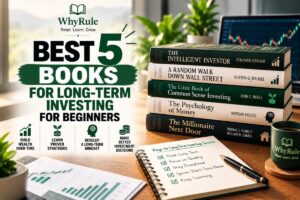
Best 5 Books for Long-Term Investing for Beginners
Introduction
Long-term investing can look simple from the outside: buy good investments, stay invested, and give your money time to grow.
But in reality, successful long-term investing requires patience, financial knowledge, emotional discipline, and the ability to understand what you actually own.
For beginners, the biggest challenge is often not finding an investment. It is learning how to think like a long-term investor.
Should you focus on company quality or valuation?
How do you identify a strong business?
What makes an investment attractive for the long run?
How important is diversification?
And perhaps most importantly, how do you avoid making emotional decisions when markets fall?
Books can provide a useful foundation for answering these questions.
In this article, we explore 5 of the best books for long-term investing for beginners, covering topics such as value investing, business quality, compounding, valuation, financial statements, and long-term decision-making.
Educational disclaimer: This article is for educational purposes only and is not financial advice. Investing involves risk, and past performance does not guarantee future results.
What Is Long-Term Investing?
Long-term investing generally means holding investments for an extended period rather than trying to profit from short-term price movements.
Depending on the investor and strategy, the time horizon can be several years or even decades.
Long-term investors may focus on:
Business quality
Earnings and cash flow
Competitive advantages
Valuation
Management quality
Industry economics
Dividend growth
Reinvestment
Compounding
Portfolio diversification
Patience
The central idea is that an investor doesn’t necessarily need to predict what a stock will do next week or next month.
Instead, the focus can be on whether the underlying investment can create value over a much longer period.
Why Should Beginners Read Books About Long-Term Investing?
The internet contains thousands of investing opinions.
One person may recommend buying a particular stock.
Another may recommend technical indicators.
Someone else may predict the next market crash.
This can make investing extremely confusing for beginners.
A good investing book can provide something that short social-media posts often don’t:
a complete framework for thinking.
Instead of learning isolated tips, you can learn concepts such as:
How businesses make money
How to read financial statements
How valuation works
Why competitive advantages matter
How compounding works
Why patience matters
How investor psychology affects decisions
Why price and value aren’t always the same
The following five books approach long-term investing from different perspectives.
Best 5 Books for Long-Term Investing for Beginners
| Book | Author | Main Investing Lesson |
|---|---|---|
| The Five Rules for Successful Stock Investing | Pat Dorsey | How to analyze companies, financial statements, moats, and valuation |
| The Dhandho Investor | Mohnish Pabrai | Think about downside protection, business quality, and attractive odds |
| 100 Baggers | Christopher W. Mayer | Understand the characteristics associated with exceptional long-term performers |
| The Joys of Compounding | Gautam Baid | Combine investing knowledge with patience, learning, and compounding |
| The Little Book That Still Beats the Market | Joel Greenblatt | Explore systematic approaches to buying good businesses at attractive prices |
Let’s look at each book in detail.
1. The Five Rules for Successful Stock Investing — Pat Dorsey
If you’re looking for a book that helps explain how to analyze individual companies, The Five Rules for Successful Stock Investing by Pat Dorsey is a useful place to start.
The book covers areas including financial statements, economic moats, company analysis, valuation, and common investing mistakes.
For a beginner, this is important because long-term investing isn’t simply about finding a company that has a popular product.
You need to understand the business behind the stock.
The Lesson: Learn to Understand the Business
Imagine someone tells you:
“This company is going to grow rapidly.”
Instead of immediately buying the stock, a long-term investor can ask:
How does the company make money?
Is revenue growing?
Are profits improving?
Does the company generate cash?
Does it have significant debt?
What makes the business different from competitors?
Can competitors easily copy it?
Is management allocating capital effectively?
Is the current valuation reasonable?
These questions move you from stock speculation toward business analysis.
Understanding Economic Moats
One of the important concepts covered by Dorsey’s approach is the idea of an economic moat.
A moat is essentially a competitive advantage that can help a business defend its position against competitors.
Examples can include:
Strong brands
Network effects
Cost advantages
Switching costs
Patents
Scale
Distribution advantages
A company with a competitive advantage may have better conditions for maintaining profitability over time, although no competitive advantage is permanent.
Why This Book Can Help Beginners
The book also covers financial statements and valuation, making it useful for readers who want to learn fundamental analysis for long-term investing.
If you’re starting to learn how to analyze stocks beyond charts and price movements, this can help build that foundation.
Key takeaway:
Before investing in a company, learn how the company actually makes money.
2. The Dhandho Investor — Mohnish Pabrai
The Dhandho Investor by Mohnish Pabrai presents a value-investing framework for individual investors and focuses on concepts such as simple businesses, durable moats, margin of safety, and making relatively few investment bets.
The book is particularly interesting for beginners because it encourages investors to think about risk and reward together.
The Lesson: Focus on Downside as Well as Upside
Many new investors ask:
“How much can this stock increase?”
A more complete question is:
“What can I potentially gain, and what could I lose if my assumptions are wrong?”
This is an important part of long-term investing.
Suppose two investments have similar potential returns.
But:
Investment A has a stronger business
Investment B has heavy debt
Investment A has more predictable cash flows
Investment B depends on a single uncertain event
The potential return alone doesn’t tell you everything.
Understanding the downside is equally important.
Margin of Safety
The concept of margin of safety is central to value investing.
In simple terms, it means avoiding situations where your investment depends on everything going perfectly.
For example, suppose you estimate that a company’s intrinsic value is ₹500 per share.
Buying at ₹490 leaves relatively little room for error.
Buying at a substantially lower price, assuming your valuation is reasonable, may provide more room for mistakes.
Of course, estimating intrinsic value itself is uncertain.
That is why valuation should never be treated as an exact science.
Simple Businesses Can Be Easier to Understand
Another useful idea is simplicity.
If you cannot explain how a business makes money in straightforward language, it may be difficult to evaluate its long-term economics.
For beginners, this is especially useful.
Before investing, ask:
“Can I explain this business to someone else in two or three sentences?”
If not, perhaps more research is required.
3. 100 Baggers — Christopher W. Mayer
100 Baggers by Christopher W. Mayer studies companies that produced 100-to-1 returns and looks for patterns among these exceptional performers. The book emphasizes practical investing concepts and states that readers don’t need an MBA or finance degree to engage with its ideas.
The title may sound ambitious, but the more useful lesson for beginners is not simply:
“Find the next 100-bagger.”
The deeper lesson is understanding what can happen when business quality and time work together.
The Lesson: Long-Term Compounding Can Be Powerful
Consider a company that grows its earnings and cash flows over many years.
If the business can reinvest capital effectively and continue growing, the value created over a long period can become much larger than short-term movements suggest.
This is the power of compounding in investing.
But there is an important distinction:
Compounding isn’t guaranteed.
A company must continue to perform.
Its competitive advantage must remain relevant.
Management must make sensible decisions.
Valuation also matters.
And investors need enough patience to allow the thesis to play out.
Look for Business Characteristics, Not Just Stock Prices
A beginner may look at a chart and think:
“This stock has already gone up a lot.”
A long-term investor can instead ask:
Is the business still growing?
Is its market opportunity expanding?
Are returns on capital attractive?
Does the company have a durable advantage?
Can earnings continue growing?
Can management reinvest profit effectively?
This is a much more fundamental way of thinking.
Why Patience Matters
One of the biggest challenges in long-term investing is that business value and stock price don’t always move together in the short term.
A good company can experience periods of:
Weak sentiment
Market corrections
Temporary earnings problems
High volatility
Investor pessimism
The long-term investor needs to distinguish between temporary price movement and permanent deterioration in the investment thesis.
4. The Joys of Compounding — Gautam Baid
The Joys of Compounding by Gautam Baid combines value-investing ideas with lessons about lifelong learning, decision-making, business, and personal development. The revised edition was published by Columbia Business School Publishing in 2020.
This book is particularly relevant for readers who want to understand that long-term investing is not simply a collection of formulas.
It is also a way of thinking.
The Lesson: Compounding Is More Than Money
When people hear “compounding,” they usually think about money.
But compounding can apply to:
Knowledge
Skills
Habits
Relationships
Decision-making
Capital
Suppose you learn something useful about investing every month.
One lesson may not seem significant.
But after five or ten years, those lessons can accumulate into a much stronger understanding of businesses and markets.
The same principle applies to capital.
Invest in Your Own Knowledge
For a beginner, one of the most important investments may be education.
Before trying to identify complicated investment opportunities, learn:
Basic accounting
Financial statements
Valuation
Business models
Competitive advantages
Risk
Portfolio construction
Investor psychology
The more you understand, the easier it becomes to separate useful information from market noise.
Long-Term Investing Requires Patience
Markets can be extremely distracting.
Every day there is:
Breaking news
Market commentary
Stock predictions
Economic forecasts
Analyst upgrades
Analyst downgrades
Social-media opinions
A long-term investor needs the ability to distinguish between information that genuinely changes the investment thesis and information that simply creates noise.
5. The Little Book That Still Beats the Market — Joel Greenblatt
Joel Greenblatt’s The Little Book That Still Beats the Market presents a systematic approach to investing based on buying good businesses at attractive prices. The 2024 third edition updates the book’s research and explains the strategy in relatively accessible language.
For beginners, one of the interesting aspects of this book is that it demonstrates how investing can be approached using a rules-based framework rather than relying entirely on predictions or emotions.
The Lesson: Create a Repeatable Process
Many beginners invest based on feelings.
For example:
“I like this company’s product.”
That’s not necessarily enough.
A repeatable process might ask:
Is the company financially healthy?
Is the business profitable?
Does it have attractive economics?
Is the stock reasonably valued?
Does it meet predefined investment criteria?
What risks could invalidate the thesis?
Having a framework can help reduce emotional decision-making.
Why Rules Can Help Investors
Markets can create strong emotions.
When prices rise:
Fear of missing out can appear.
When prices fall:
Fear and panic can appear.
A rules-based process can provide structure.
However, no formula guarantees superior returns, and historical strategies may behave differently across market environments.
That distinction is important for beginners.
What These 5 Books Teach About Long-Term Investing
Although these books use different approaches, several common principles appear.
1. Think Like a Business Owner
Instead of asking:
“Will the stock price rise tomorrow?”
Ask:
“What am I actually owning?”
If you’re buying shares of a company, you’re buying an ownership interest in a business.
Understanding the business can therefore be more useful than obsessing over every daily price movement.
2. Focus on Business Quality
Long-term investors often examine:
Revenue growth
Profitability
Cash generation
Return on capital
Debt
Competitive advantages
Management
Industry structure
No single metric tells the complete story.
The goal is to understand the business as a whole.
3. Valuation Still Matters
A great company isn’t automatically a great investment at any price.
Imagine two investors buying the same excellent business.
Investor A buys at a reasonable valuation.
Investor B buys at an extremely high valuation because everyone is excited about the company.
Their future returns can be very different.
That’s why stock valuation for beginners is an important topic to learn.
4. Compounding Requires Time
Compounding works best when capital has time to grow.
This is why long-term investors often focus on:
Time in the market rather than constantly trying to predict short-term market movements.
However, long-term investing does not mean blindly holding something forever.
If the business deteriorates materially or the original investment thesis changes, reassessment may be necessary.
5. Don’t Confuse a Falling Price With a Bargain
A stock falling 40% does not automatically mean it has become cheap.
The underlying business may also have deteriorated.
For example:
Before the decline
Company:
Strong business
Good growth
Healthy balance sheet
After the decline
Company:
Falling revenue
Increasing debt
Losing market share
Weakening competitive position
The stock price may be lower, but the investment may also be fundamentally weaker.
This is why fundamental analysis matters.
6. Patience Is a Competitive Advantage
Short-term markets can be noisy.
Long-term investors don’t necessarily need to react to every movement.
If the original thesis remains intact, temporary volatility may not change the long-term investment case.
But patience should not become stubbornness.
There is a difference between:
“The market is temporarily ignoring this business.”
and
“I refuse to admit that my analysis was wrong.”
A disciplined investor should be willing to reconsider an investment when the facts change.
7. Avoid Emotional Investing
Three emotions frequently affect investors:
Fear
A falling market can create panic.
Greed
Rapidly rising prices can encourage excessive risk-taking.
FOMO
Seeing other people make money can create pressure to buy without adequate research.
A written investment process can help reduce the influence of these emotions.
Long-Term Investing vs Short-Term Trading
Understanding the difference can help beginners choose the right learning material.
| Long-Term Investing | Short-Term Trading |
|---|---|
| Multi-year horizon | Shorter holding periods |
| Business fundamentals often important | Price action and market behavior often important |
| Compounding is central | Timing is more important |
| Lower transaction frequency may be possible | More frequent transactions |
| Patience is important | Execution speed can matter |
| Valuation can play a major role | Technical and tactical factors may play a larger role |
Neither approach is automatically suitable for every person.
Your time, knowledge, risk tolerance, financial goals, and investment horizon matter.
How Beginners Can Start Long-Term Investing
Reading books is useful, but applying the lessons is where the real learning begins.
Here is a simple framework.
Step 1: Understand Your Goal
Ask:
Why am I investing?
What is my time horizon?
What financial goal am I working toward?
Step 2: Build Basic Financial Knowledge
Learn:
Revenue
Profit
Cash flow
Assets
Liabilities
Debt
Return on capital
Valuation
You don’t need to become an accountant.
But you should understand the basic language of investing.
If you’re just starting out, these stock market books for beginners can help you build a broader foundation in investing and market basics.
Step 3: Study Businesses
Choose companies you understand.
Read about:
What they sell
Who their customers are
Their competitors
Their industry
Their financial performance
Their risks
Step 4: Understand Valuation
Learn the difference between:
Price
and
Value
They are related, but they are not identical.
Step 5: Diversify Appropriately
Putting all your money into one company creates concentration risk.
Diversification can help reduce the impact of an individual investment performing poorly, although it cannot eliminate investment risk.
Step 6: Create an Investment Checklist
Before buying, ask:
Do I understand the business?
Why do I think it can perform well?
What are its biggest risks?
Does it have competitive advantages?
Is its balance sheet healthy?
Is the valuation reasonable?
What could prove my thesis wrong?
Does the investment fit my portfolio?
Common Mistakes Beginners Make in Long-Term Investing
Mistake 1: Buying Based on Social Media
A popular stock isn’t automatically a good investment.
Mistake 2: Checking Prices Every Few Minutes
If you’re investing for ten years, checking the price ten times a day may create unnecessary emotional reactions.
Mistake 3: Ignoring Valuation
A wonderful business purchased at an unreasonable price can still produce disappointing returns.
Mistake 4: Buying What You Don’t Understand
Complex businesses can be difficult to analyze.
Understanding your investment is an important part of risk management.
For a deeper understanding of protecting your capital, explore these risk management books for investors and traders.
Mistake 5: Selling Because of Temporary Volatility
A market decline doesn’t automatically mean the underlying business is broken.
Mistake 6: Holding a Broken Investment Forever
“Long-term” doesn’t mean “never sell.”
If the fundamentals change materially, investors may need to reassess the original thesis.
Mistake 7: Expecting Quick Results
Long-term investing is designed around a longer time horizon.
Trying to turn every investment into a quick profit can encourage behavior that conflicts with a long-term strategy.
Which of These Books Should a Beginner Read First?
There is no universal reading order, but you can approach the books according to what you want to learn.
Want to understand company analysis?
Start with The Five Rules for Successful Stock Investing.
Want to understand value investing and downside protection?
Explore The Dhandho Investor.
Interested in exceptional long-term business performance?
Read 100 Baggers.
Want a broader philosophy around investing and compounding?
Explore The Joys of Compounding.
Interested in systematic investing?
Study The Little Book That Still Beats the Market.
A useful approach is to read one book, take notes, and then apply the concepts to companies you are studying.
A Simple Long-Term Investing Checklist
Before making an investment decision, save this checklist:
Business
☐ Do I understand what the company does?
☐ How does it make money?
☐ Does it have a competitive advantage?
Financials
☐ Is revenue healthy?
☐ Is the company profitable?
☐ Does it generate cash?
☐ Is debt manageable?
Valuation
☐ Is the current price reasonable?
☐ What assumptions are built into the valuation?
Risk
☐ What could go wrong?
☐ What is the biggest threat to the business?
☐ How would the investment affect my overall portfolio?
Time Horizon
☐ Am I prepared to hold for several years?
☐ What would make me reconsider the investment?
This checklist isn’t a guarantee of success.
Its purpose is to encourage disciplined thinking.
Final Thoughts
Long-term investing isn’t about finding a magical stock or predicting the market perfectly.
It’s about developing a process.
The Five Rules for Successful Stock Investing can help beginners understand company analysis, financial statements, economic moats, and valuation.
The Dhandho Investor explores value investing, downside protection, simple businesses, and capital allocation.
100 Baggers examines characteristics associated with exceptional long-term investment outcomes and the role of business growth.
The Joys of Compounding connects value investing with lifelong learning, decision-making, and the broader idea of compounding.
The Little Book That Still Beats the Market introduces a systematic approach to evaluating good businesses at attractive prices and has been updated in its 2024 edition.
The most important lesson is simple:
Long-term investing is less about predicting tomorrow and more about understanding what you own, managing risk, and giving good decisions enough time to work.
Keep learning. Keep questioning your assumptions. Keep your expectations realistic.
And remember:
Read. Learn. Grow.