
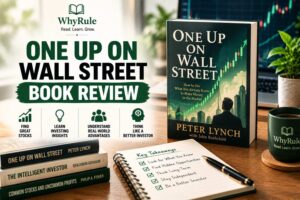
One Up on Wall Street Book Review: Is Peter Lynch’s Investing Strategy Still Useful for Beginners?
Introduction
If you are new to stock market investing, one of the biggest questions you may have is:
How do I find good companies before the rest of the market notices them?
That question sits at the heart of One Up on Wall Street by Peter Lynch.
Published in 1989, the book became one of the most widely discussed investing books because Lynch presents a relatively accessible idea: ordinary investors may encounter useful investment information through their everyday lives, but they still need to research and understand a company before investing.
Rather than encouraging readers to blindly follow Wall Street analysts or chase complicated financial theories, Lynch explains how investors can look for businesses they understand and then investigate whether those businesses actually have attractive investment characteristics.
But is One Up on Wall Street still worth reading today?
Yes, as an educational book on stock-picking and fundamental investing—but it should be read as a framework, not as a guarantee of investment success.
In this detailed One Up on Wall Street book review, we’ll explore Peter Lynch’s investment philosophy, the famous “invest in what you know” idea, how Lynch categorized companies, what beginners can learn from the book, its strengths and limitations, and whether it deserves a place on your investing bookshelf.
Important: This article is for educational purposes only and is not financial advice. Investing in individual stocks involves risk, and past performance does not guarantee future results.
One Up on Wall Street at a Glance
| Detail | Information |
|---|---|
| Book | One Up on Wall Street |
| Author | Peter Lynch |
| First Published | 1989 |
| Subject | Stock market investing |
| Main Approach | Fundamental, company-focused investing |
| Best For | Beginners and individual investors |
| Key Theme | Finding and researching companies you understand |
| Investment Horizon | Primarily long-term |
| Difficulty | Beginner to intermediate |
| Category | Investing / Stock Market |
| Why Read It? | To understand how individual investors can research companies |
Who Is Peter Lynch?
Before reviewing One Up on Wall Street, it helps to understand who Peter Lynch is.
Peter Lynch is a well-known American investor who managed Fidelity Magellan Fund from 1977 to 1990.
During his tenure, the fund experienced substantial growth and Lynch became widely known for his stock-picking approach.
His reputation is important because One Up on Wall Street isn’t simply a collection of generic investing tips.
The book is largely an explanation of how Lynch approached finding and evaluating companies.
However, beginners should make an important distinction:
Learning from a successful investor’s historical approach is not the same as being able to reproduce their historical results.
Markets, technology, regulations, businesses, and competitive environments change.
The useful takeaway is therefore the process of thinking about businesses, rather than attempting to copy individual historical investments.
What Is One Up on Wall Street About?
At its core, One Up on Wall Street is about individual investors and the potential advantages they may have when observing businesses in everyday life.
For example, you might notice:
- A restaurant becoming extremely popular
- A particular product appearing everywhere
- A retailer attracting more customers
- A brand gaining popularity
- A company expanding rapidly
- A product receiving strong consumer demand
Lynch’s argument is not simply:
“I like this product, so I should buy the stock.”
That’s an important distinction.
The observation is only the starting point.
The next step is research.
You need to investigate the company, understand its financial condition, examine its growth prospects, consider valuation, and understand the risks.
So the basic process becomes:
Notice → Research → Understand → Evaluate → Decide
This is one of the most valuable lessons beginners can take from the book.
“Invest in What You Know” — What Does Peter Lynch Really Mean?
This is probably the most famous idea associated with One Up on Wall Street.
The phrase is often simplified into:
“Buy what you know.”
But that interpretation can be dangerous.
Lynch’s broader idea is better understood as:
Your everyday knowledge can help you discover potential investment ideas, but it does not replace financial research.
Imagine you regularly use a particular company’s products.
You notice that:
- The product is popular.
- More people are using it.
- Stores are expanding its shelf space.
- Customers seem loyal to the brand.
That could make the company interesting enough to investigate.
But it doesn’t automatically make the stock a good investment.
You still need to ask:
- Is the company profitable?
- Is revenue growing?
- How much debt does it have?
- Is the stock fairly valued?
- Is the growth sustainable?
- What competitors could threaten it?
- What could go wrong?
That’s the difference between observation and investment analysis.
Why “Invest in What You Know” Can Be Powerful for Beginners
Beginners often think investing requires understanding every industry.
It doesn’t.
You don’t need to become an expert in every sector before you can begin learning about investing.
You can start with businesses that operate in areas you already understand.
For example, suppose you’re interested in:
- Banking
- Automobiles
- Consumer products
- Technology
- Retail
- Healthcare
- Food and beverages
You can begin learning how companies in that industry make money.
Then you can gradually develop the ability to analyze businesses more systematically.
This can make the stock market feel less abstract.
But There Is a Major Trap
Here’s where beginners can misunderstand Lynch.
Knowing a company is not the same as knowing whether its stock is attractive.
You might love a company’s product.
That doesn’t necessarily mean the company is an attractive investment at its current valuation.
A wonderful business can become a poor investment if you pay an excessively high price.
This is one of the most important lessons to remember when applying the ideas in One Up on Wall Street.
Product quality ≠ Investment quality
You need to examine both:
The business
and
The price you’re paying for the business.
Peter Lynch’s Six Types of Companies
One of the most useful sections of One Up on Wall Street is Lynch’s classification of companies.
He broadly divides companies into six categories.
Understanding these categories can help beginners think about what kind of investment opportunity they’re actually looking at.
1. Slow Growers
These are mature companies where growth is generally slower.
They may operate in established industries with relatively limited expansion opportunities.
Investors may be interested in them for reasons such as income or stability rather than dramatic growth.
Beginner Lesson
Don’t expect every company in your portfolio to become a huge growth story.
Different companies can serve different purposes.
2. Stalwarts
Stalwarts are large, established companies with relatively dependable businesses.
They aren’t necessarily explosive growth companies.
Instead, investors may look to them for more moderate growth and resilience.
A beginner can learn an important lesson here:
A good company doesn’t have to be a spectacular company.
Sometimes an established business with a strong competitive position can be valuable in a portfolio.
3. Fast Growers
This is perhaps the most exciting category for growth-oriented investors.
Fast growers are companies capable of growing earnings and revenues at relatively high rates.
But high growth comes with an important question:
How long can that growth continue?
A company growing rapidly today may eventually face:
- Larger competitors
- Market saturation
- Rising costs
- Regulatory challenges
- Changing consumer preferences
- Slower demand
Therefore, investors need to examine whether growth is sustainable.
4. Cyclicals
Cyclical companies operate in industries where business performance can move significantly with economic conditions.
Examples can include industries connected to:
- Automobiles
- Manufacturing
- Commodities
- Construction
When the economic environment is favorable, these businesses can perform strongly.
When conditions weaken, their performance can decline.
Beginner Lesson
A company can look extremely attractive at the peak of its business cycle—and that can be precisely when investors need to be careful.
Understanding the economic cycle is therefore important.
5. Turnarounds
Turnaround companies are businesses that have experienced significant difficulties but may have the potential to recover.
The investment thesis depends on the possibility that the company can solve its problems.
But turnarounds can be risky.
The company may fail to recover.
Therefore, investors need to understand:
- What caused the problems?
- What is management doing?
- Is the balance sheet strong enough?
- Is the turnaround realistic?
- What happens if recovery takes longer than expected?
6. Asset Plays
An asset play is a company where the value of its assets may not be fully reflected in the market price.
The assets could potentially include:
- Real estate
- Natural resources
- Investments
- Cash
- Other valuable holdings
The key challenge is determining whether those assets are actually worth what investors believe they are worth.
Why These Categories Matter
The six categories give beginners a useful mental model.
Instead of looking at every stock in exactly the same way, you can ask:
“What type of company am I analyzing?”
A fast-growing company should not necessarily be evaluated in exactly the same way as a cyclical company.
A turnaround requires different questions from a stable large company.
This makes the framework practical for learning fundamental stock analysis.
What Does Peter Lynch Look for in a Company?
One of the strengths of One Up on Wall Street is that Lynch encourages readers to go beyond the company’s popularity.
When researching a company, investors should examine its fundamentals.
Important areas include:
Revenue Growth
Is the company generating more sales over time?
Earnings Growth
Are profits increasing?
Debt
Does the company have manageable debt, or is its balance sheet becoming a problem?
Competitive Position
What makes the company difficult to compete with?
Business Model
How does the company actually make money?
Valuation
Is the stock price reasonable relative to the company’s fundamentals and future expectations?
Growth Potential
Can the company continue growing?
Industry Conditions
Is the broader industry expanding or contracting?
These questions remain useful even though the book was first published decades ago.
Why Valuation Matters
One of the biggest mistakes beginners make is focusing entirely on company quality.
Imagine two companies.
Company A
- Excellent brand
- Strong profits
- Growing sales
- Good management
Company B
- Similar quality
- Similar growth
- Similar business strength
But suppose Company A’s stock trades at a dramatically higher valuation than Company B.
The investment decision cannot simply be:
“Company A is a great company, so I’ll buy it.”
The price matters.
This is why valuation is an important part of fundamental investing.
The P/E Ratio in Simple Terms
One valuation measure frequently discussed in stock market analysis is the price-to-earnings ratio, commonly called the P/E ratio.
In simplified terms:
P/E = Share Price ÷ Earnings Per Share
For example, if a stock trades at ₹200 and its earnings per share are ₹10:
P/E = ₹200 ÷ ₹10 = 20
That means investors are paying ₹20 for every ₹1 of current earnings.
But a P/E ratio shouldn’t be interpreted in isolation.
You may want to compare it with:
- Historical valuations
- Competitors
- Expected growth
- Industry characteristics
- Profitability
- Interest rates
- Business quality
A low P/E doesn’t automatically mean a stock is cheap.
A high P/E doesn’t automatically mean it is expensive.
The context matters.
One Up on Wall Street and Fundamental Analysis
One Up on Wall Street is particularly useful for readers who want to understand fundamental stock analysis.
Fundamental analysis attempts to evaluate a business using information such as:
- Revenue
- Earnings
- Cash flow
- Debt
- Assets
- Competitive advantages
- Industry conditions
- Management
- Valuation
This differs from purely technical approaches that primarily study price and volume patterns.
For beginners, understanding this distinction is valuable.
Fundamental Analysis vs Technical Analysis
| Fundamental Analysis | Technical Analysis |
|---|---|
| Studies the business | Studies price/volume behavior |
| Revenue and earnings | Charts and patterns |
| Valuation | Momentum |
| Balance sheet | Support/resistance |
| Competitive position | Indicators |
| Long-term business prospects | Market price behavior |
Neither table column should be treated as a guaranteed method of making money.
They represent different ways of analyzing markets.
One Up on Wall Street is much more closely associated with the fundamental/company-analysis side of investing.
What Beginners Can Learn From One Up on Wall Street
There are several lessons that make this book valuable for new investors.
1. Start With Businesses You Understand
You don’t need to analyze every company in the market.
Begin with industries and businesses that you can understand.
2. Do Your Own Research
A stock tip isn’t an investment thesis.
Research the company yourself.
Understand why you believe the company may perform well.
3. Look Beyond the Stock Price
A stock trading at ₹50 isn’t automatically cheaper than one trading at ₹500.
The share price alone tells you very little.
You need to consider the company’s overall valuation.
4. Understand What Can Go Wrong
Investing isn’t just about finding reasons to buy.
You should actively search for reasons your thesis could be wrong.
Ask:
“What would make this company fail?”
That question can improve your analysis.
5. Know What You Own
This is one of the most important lessons for beginners.
If you can’t explain how a company makes money in simple language, you probably need to research it further.
What I Like About One Up on Wall Street
Beginner-Friendly Philosophy
Lynch explains investing in a way that can be easier for beginners to understand than highly technical financial literature.
Focus on Real Businesses
The book encourages readers to think about companies as actual businesses rather than simply stock symbols moving up and down on a screen.
Practical Classification System
The six company categories provide a useful framework for organizing investment ideas.
Encourages Independent Thinking
Rather than simply following market commentators, the book encourages readers to develop their own research process.
Strong Educational Value
Even if you don’t agree with every aspect of Lynch’s methodology, the book can teach you how to ask better questions about businesses and investments.
Limitations of One Up on Wall Street
No investing book should be treated as perfect.
One Up on Wall Street also has limitations that modern readers should understand.
1. The Market Has Changed
The book was published in 1989.
Today’s markets include:
- Algorithmic trading
- ETFs
- High-frequency trading
- Social media
- Digital businesses
- Globalized supply chains
- New financial products
Therefore, readers should distinguish timeless investing principles from historical market circumstances.
2. Past Success Doesn’t Guarantee Future Results
Peter Lynch’s historical track record is impressive, but that doesn’t mean an individual investor can simply copy his approach and achieve similar returns.
Investment results depend on:
- Valuation
- Timing
- Business performance
- Market conditions
- Portfolio construction
- Risk management
- Investor behavior
3. “Invest in What You Know” Can Be Misused
This is perhaps the biggest beginner trap.
You might know a company’s products extremely well.
That doesn’t mean you understand:
- Its financial statements
- Its valuation
- Its competitive position
- Its capital structure
- Its future growth potential
Consumer familiarity should be the starting point for research, not the conclusion.
Is One Up on Wall Street Still Relevant Today?
Yes—but with context.
The technology and financial markets have changed significantly since the book was published.
However, several core questions remain relevant:
What does this company do?
How does it make money?
Is the business growing?
What are its risks?
How strong is its financial position?
What could make the investment thesis fail?
Am I paying a reasonable price?
These questions aren’t limited to one particular decade.
That’s why One Up on Wall Street can still be valuable as an investment education book, even though modern investors should supplement it with current financial data and contemporary market knowledge.
One Up on Wall Street: Pros and Cons
| Pros | Cons |
|---|---|
| Beginner-friendly | Written in a very different market era |
| Practical investing framework | Some examples are historical |
| Encourages independent research | Can be oversimplified by inexperienced readers |
| Explains company categories | Doesn’t provide a complete modern portfolio strategy |
| Focuses on businesses | Individual stock investing still carries significant risk |
| Useful introduction to fundamental analysis | Historical success shouldn’t be treated as a guarantee |
Who Should Read One Up on Wall Street?
This book is particularly suitable for:
Beginners
If you’re starting to learn stock market investing, the book can introduce fundamental concepts without requiring advanced financial knowledge.
Individual Investors
It can be especially interesting for people who want to learn how to research individual companies.
Long-Term Investors
Readers interested in company fundamentals and long-term investment ideas may find the book particularly useful.
Students of Investing
If you’re building a personal library of investing books, One Up on Wall Street provides an important historical perspective on individual stock analysis.
Who May Not Enjoy This Book?
The book may not be the best starting point if your primary interest is:
- Day trading
- Short-term technical analysis
- Options trading
- Futures
- Algorithmic trading
- High-frequency trading
Its focus is much more aligned with individual-company research and fundamental investing.
How Beginners Should Read One Up on Wall Street
Don’t read it simply looking for stock recommendations.
Instead, read it looking for a research process.
After each major idea, ask yourself:
Question 1
What type of company am I looking at?
Question 2
Why do I think this company can succeed?
Question 3
What evidence supports that belief?
Question 4
What risks could invalidate my thesis?
Question 5
Is the stock valuation reasonable?
This approach turns the book from entertainment into an educational exercise.
A Simple Peter Lynch-Inspired Stock Research Checklist
If you’re learning fundamental investing, you can create a basic checklist inspired by the book’s philosophy.
Before researching a company further, ask:
Business
- What does the company sell?
- How does it make money?
- Who are its customers?
Growth
- Is revenue growing?
- Are earnings growing?
- What could drive future growth?
Financial Health
- How much debt does it have?
- Is cash flow healthy?
- Is profitability improving?
Competition
- Who are its competitors?
- Does the company have a meaningful competitive advantage?
Valuation
- What is the P/E ratio?
- How does the valuation compare with its own history and peers?
- What growth expectations are already reflected in the price?
Risk
- What could go wrong?
- What would make the investment thesis invalid?
Final Question
“If I couldn’t see the stock price for the next year, would I still understand why I own this business?”
That’s a useful question for any long-term investor.
One Up on Wall Street vs Other Investing Books
If you’re building a broader stock market reading list, different books can serve different purposes.
| Investing Topic | What to Look For |
|---|---|
| Understanding individual companies | One Up on Wall Street |
| Understanding market theory | Books focused on market efficiency and asset allocation |
| Long-term portfolio construction | Books focused on diversification and costs |
| Investing psychology | Books focused on behavioral finance |
| Technical trading | Books focused on charts and price action |
This is why it’s better to build your investing knowledge gradually rather than searching for one book that promises to teach everything.
Final Verdict: Is One Up on Wall Street Worth Reading?
One Up on Wall Street is worth reading if you want to understand how individual investors can think about companies, research investment ideas, and approach fundamental stock analysis.
Its biggest strength isn’t a secret formula for beating the market.
Its real value is the mindset it encourages:
Observe businesses.
Research them.
Understand the fundamentals.
Think independently.
Consider valuation.
Understand the risks.
The famous “invest in what you know” idea is most useful when interpreted correctly.
Don’t buy a stock simply because you like its product.
Instead:
Notice → Investigate → Analyze → Value → Decide
That distinction can make a major difference in how a beginner approaches the stock market.
And perhaps the most important lesson is that investing is not about finding a magical stock-picking shortcut.
It’s about developing the ability to understand businesses and make decisions based on evidence rather than excitement, headlines, or market noise.
For someone building a foundation in stock market investing, One Up on Wall Street remains a valuable book to study—especially when combined with modern financial data and a broader understanding of diversification, risk, valuation, and investor psychology.
Read. Learn. Grow.